
Precision Blade Engineering
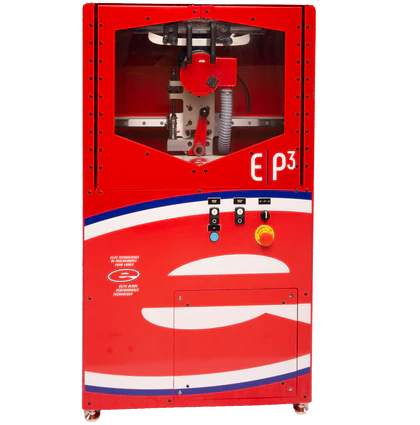
Elite E-P3 Skate Profiling
The most precise, efficient, and versatile profiling machine on the market today. Available exclusively at The Ice Box in Harbor City.
Starting at $39.99
What is Skate Profiling?
Skate profiling is the process of customizing the radius (or multiple radii) of your blade's contact with the ice. Unlike sharpening, which creates the hollow between edges, profiling changes the actual shape of the blade from heel to toe.
The Elite E-P3 machine offers precision re-profiling while removing the least amount of material possible, extending blade life and delivering NHL-level performance.
Key Takeaways: Elite E-P3 Profiling
- Profiling customizes the blade radius for your specific position, weight, and skating style.
- The Elite E-P3 machine delivers NHL-level precision while removing minimal blade steel.
- Options range from Duo, Triple, Quad, to specialized Goalie profiles.
Understanding Profile Zones
A skate blade is divided into distinct zones, each optimized for a specific aspect of skating performance:
1. Acceleration Zone (Toe)
The front-most part of the blade, used for quick starts and generating initial momentum.
2. Transition/Agility Zone (Ball of Foot)
Used for quick turns, pivots, and seamless transitions between acceleration and top speed.
3. Speed/Glide Zone (Arch/Mid)
The largest section, designed for maximizing glide and maintaining top speed with powerful strides.
4. Stability Zone (Heel)
The rear part of the blade, providing balance, control, and support during stops and hard pushes.
Key Advantages
- Precision measurement and execution
- Minimal material removal for extended blade life
- Can re-profile previously profiled blades
- Multiple blades profiled simultaneously
- Profiles used by NHL players including Sidney Crosby and Evgeni Malkin
Not Sure Which Profile is Right?
Stop guessing. Take our 2-minute assessment to get a personalized recommendation based on your skating style, weight, and position.
Take the Profiling QuizAvailable Profile Options
Double.1 (7-13)
DuoDynamic profile with aggressive acceleration and stable glide. Features a significant forward pitch bias.
Double.2 (8-12)
DuoBalanced dual-radius profile. Similar to Double.1 but with a more neutral weight distribution.
Double.3 (9.5-10.5)
DuoConservative upgrade from stock profiles. Maintains a familiar feel while slightly enhancing agility and stability.
Double (7-14)
DuoHigh-contrast dual radius for aggressive acceleration and maximum longitudinal stability.
Double (8-14)
DuoBalanced acceleration and maximum stability dual radius.
Double (8-13)
DuoStandard performance dual radius. Balanced for agility and stability.
Double (10-11)
DuoMinimal-variance dual radius. Extremely stable baseline upgrade.
Pitch Options
Add precise forward pitch to any profile for enhanced acceleration and power transfer. Pitch moves your weight forward onto the balls of your feet for a more aggressive skating stance.
| Code | Name | Offset | Description |
|---|---|---|---|
| N | Neutral | 0mm | No additional pitch - natural blade position |
| P1 | Slight | ~8mm | Subtle forward lean for enhanced acceleration |
| P2 | Moderate | ~16mm | Noticeable forward pitch for aggressive skating |
| P3 | Aggressive | ~24mm | Maximum forward pitch for explosive power |
Frequently Asked Questions
How often should I get my skates profiled?
Profiling is typically done once and maintained through regular sharpening. You may want to re-profile if you've had significant blade material removed over time, if you're trying a new profile, or if your skating style has changed.
Which profile should I choose?
The best profile depends on your skating style, position, and preferences. Duo profiles (7-13, 8-12, 9.5-10.5) are great starting points with proven versatility. Triple profiles like the EL3.1 (available in Large, Standard, and Junior sizes) are our most popular all-around choice. Quad profiles (4.1 and 4.2 with EL variants, plus our proprietary Polaris series) offer maximum versatility and performance. Center Glide (SCS) profiles (SCS-1, SCS-2, SCS-3 with size options) provide elite-level edge performance. Center Flat profiles (40mm to 80mm with multiple pitch options) are used by NHL stars for maximum control. Mono profiles (7' to 30') offer traditional single-radius options for specialized performance. For goalies, we offer specialized 26-30 Duo, 26'-30' Duo, 28' Mono, and 30' Mono profiles. We're happy to discuss your needs and recommend the best option.
Can I try a different profile if I don't like my current one?
Yes! The Elite E-P3 can re-profile previously profiled blades. However, keep in mind that each profiling removes a small amount of material, so we recommend giving your current profile at least 2-3 skates to adapt before switching.
What's the difference between profiling and sharpening?
Sharpening creates the hollow between your edges (inside-outside), while profiling shapes the blade's contact with the ice from heel to toe (front-back). Both are essential for optimal performance but serve different purposes.
What is the difference between a radius and a profile?
A radius is a single curve on the blade, while a profile is a combination of multiple radii. A profile can also include a flat spot, which is a section of the blade that has no curve.
How do I know which profile is right for me?
The best way to find the right profile is to try a few different ones. We can help you choose a few profiles to try based on your skating style, position, and personal preferences.
How long does it take to get used to a new profile?
It usually takes a few hours of skating to get used to a new profile. We recommend that you skate on your new profile for at least 2-3 hours before you decide if you like it or not.
Quad vs Triple Blade Profile
Learn the differences and which profile type suits your position.
Read guide →
Professional Skate Sharpening
Profiling and sharpening work together — see our full service menu.
View services →
Skate Sharpening Hollow Guide
Choose the right hollow (ROH) to complement your blade profile.
Read guide →
Ready to Elevate Your Game?
Experience the difference that professional Elite E-P3 profiling can make in your skating performance. Visit us today to discuss your profiling options.